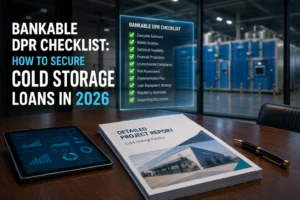
You have the land and a vision, but your loan application keeps hitting a wall. In 2026, banks aren’t just looking for a simple project report; they want a Bankable DPR for cold storage 2026. With credit norms tightening, your Detailed Project Report (DPR) must prove that your facility isn’t just a building, but a low-risk, high-efficiency asset.
This guide provides a straightforward checklist to help your financing get the green light, covering everything from financial ratios to technical certifications.
What Makes a DPR “Bankable” in 2026?
A “bankable” report is essentially a risk assessment that speaks the language of a bank manager. While a general report describes your idea, a bankable DPR proves its survival. It focuses heavily on asset quality—proving that the machinery and insulation you are buying will outlast the loan itself.
In today’s banking climate, creditworthiness is about “project viability.” Lenders want to see that your running costs are low and that you have a plan to survive the initial months before you reach full capacity.
The 5 Pillars of a Bankable DPR:
- Financial Viability: Clear proof of cash flow and debt-handling capacity.
- Technical Feasibility: Evidence of modern, energy-efficient refrigeration.
- Statutory Compliance: A roadmap for all local and national permits.
- Promoter Background: Your experience or the expertise of your partners.
- Market Linkage: Proof of demand (MOUs or letters of intent from clients).
Key Insight: A DPR is your professional sales pitch. If it doesn’t show how you will handle risks, the bank won’t consider it bankable.
The Financial Pillar: Metrics Lenders Can’t Ignore
When a bank reviews a cold storage project report for bank loan approval, they look at the numbers first. They need to know if the project can pay for its own electricity, staff, and maintenance while still having enough left to pay back the loan.
Most banks expect a Debt-Equity ratio of roughly 2:1 or 3:1. This means you should be ready to put in 25% to 33% of the project cost as your own “margin money.”
Debt Service Coverage Ratio (DSCR) Explained
The minimum DSCR for cold storage is the most important number in your DPR. This ratio measures your ability to pay back the loan using your profit. Most Indian banks look for a DSCR of 1.25 or higher.
Essentially, a 1.25 ratio means that for every ₹100 you owe the bank, your business earns ₹125. This ₹25 “cushion” ensures you can still pay the bank even if electricity prices spike or you have a slow month.
CMA Data: The Heart of Your Application
The Credit Monitoring Arrangement (CMA) data is a set of financial statements that predict your performance over the next 7 to 10 years. In 2026, banks require CMA data for cold storage bank loan applications to be professionally prepared. It shows the bank exactly how you will handle the “Moratorium Period”—the first 12 to 24 months where you may only pay interest while the facility gets started.
| Financial Metric | Target Benchmark (2026) | Why it matters |
| DSCR | > 1.25 | Safety net for loan repayment. |
| Current Ratio | > 1.33 | Ability to cover short-term debts. |
| Debt-Equity | 2:1 to 3:1 | Your personal financial stake. |
| Break-Even Point | Year 4 or 5 | When the project pays for itself. |
The Technical Pillar: Proving Asset Longevity
Banks fear an asset that breaks down before the loan is paid off. In your technical feasibility report for cold room approval, you must prove your facility is built for a 15- to 20-year life.
Lenders are now looking for high-performance insulation. Your report should highlight high-density PUF panels (100mm to 120mm thick). Highlighting the use of precision-engineered Cold Room Doors is also vital, as these are the main spots where cold air leaks out.
Why Machinery Choice Matters
Your machinery is the “heart” of the facility. Bankers see unbranded, cheap compressors as a high risk. Choosing trusted brands with variable frequency drives (VFDs) shows the bank you are prioritizing energy efficiency. Banks will also want to see a signed AMC (Annual Maintenance Contract) to ensure the equipment stays in good shape.
The Compliance Pillar: 2026 Statutory Checklist
In 2026, banks are very strict about “compliance risk.” If a facility is built without the right permits, the bank risks the project being shut down. For projects in Bangalore, this means getting BBMP or BMRDA clearances.
Your DPR must include:
- FSSAI License: For food safety and storage.
- Pollution Control Board NOC: A mandatory requirement for refrigeration equipment.
- Trade License & Fire Safety: Standard industrial permits.
Land Titles and Site Feasibility
The biggest reason for loan delays in India is land record issues. Land conversion for cold storage (CLU) is a mandatory step. If your land is registered as agricultural, you must convert it to industrial use before the bank releases any funds. They also check for “Site Feasibility,” like having 40-foot road access for large trucks.
The Market Linkage Pillar: Proving Revenue
A banker’s final question is: Who is going to pay you? You must prove demand through market linkage. The strongest proof is a formal off-take agreement or an MOU with local farmers, retailers, or pharma companies.
Subsidies as Support
While a subsidy isn’t “collateral,” it is a huge help. Mentioning your plan to follow the NHB subsidy process reduces the bank’s risk because they know the government will eventually reimburse part of the project cost.
Top 5 Reasons Cold Storage Loans Get Rejected
- Poor Tech Specs: Using thin insulation or low-quality cooling units suggests high electricity bills and risk.
- Weak Promoters: Lack of experience or a technical partner makes bankers nervous.
- Low Margin Money: Trying to borrow 90% of the cost is usually an automatic “No.”
- Unrealistic Numbers: Overestimating how fast you will fill the facility.
- Land Issues: Building on agricultural land without proper conversion papers.
FAQs: Securing Finance in 2026
Is a 100% loan possible?
No. Banks expect you to put in 25% to 35% as equity. You can use subsidies to get some of this back later, but you need the cash upfront.
What is the “Moratorium Period”?
It’s a grace period (usually 12–24 months) where you only pay interest. This gives you time to finish building and find customers before the full repayments start.
What are the interest rates?
In 2026, expect rates between 9% and 12.5%, depending on your credit score and the project’s strength.
Practical Action Steps: Your Roadmap
- Get Real Quotes: Contact a manufacturer for bank-ready machinery quotes.
- Check Your Land: Ensure your land is converted and has clear titles.
- Hire a Professional: Have a CA prepare your CMA data to ensure your ratios look strong.
- Sign MOUs: Get letters from potential clients to prove you have a market.
- Apply Early: Start your FSSAI and Pollution Board paperwork now; showing they are “in progress” helps with the bank.
By following this roadmap, you turn your project from a simple idea into a Bankable DPR for cold storage 2026, making it much easier to get the funding you need. For long-term peace of mind, ensure you have a solid maintenance strategy included in your plan.
Visit our Google My Business listing to see our recent custom installations! Call Cold Smith Enterprises Today: +91-9632758132