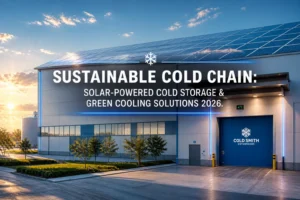
In 2026, the Indian cold chain is facing a massive shift. As energy prices fluctuate and carbon tax regulations move from policy to practice, a Sustainable cold chain solution 2026 is no longer a luxury it’s a survival strategy. The days of ignoring high electricity bills and aging, leaky refrigeration units are over. This guide breaks down how to integrate solar-powered technology, eco-friendly cooling, and smart building designs to create a facility that is both profitable and environmentally responsible.
The Shift to Net-Zero: Defining the 2026 Sustainable Cold Chain
In the industrial refrigeration sector, sustainability has evolved from a vague corporate goal into a strict requirement for ESG compliance. A “Green Cold Chain” is a technical framework designed to reach net-zero emissions through four distinct pillars: energy generation, low-impact refrigerants, high-performance insulation, and predictive automation.
For business owners in Bangalore and across India, this shift is driven by decarbonization. Reducing your carbon footprint isn’t just about the environment, it’s about protecting your business from the volatility of traditional energy grids. By adopting sustainable practices, facilities are significantly lowering their operational risks while improving their overall ROI of 5000 MT cold storage through lower monthly bills.
The 4 Pillars of a Sustainable Cold Chain:
- Renewable Energy: Shifting from coal-heavy grids to on-site solar photovoltaic (PV) systems.
- Green Refrigerants: Moving away from high-GWP (Global Warming Potential) gases toward natural cooling agents like CO2 or Ammonia.
- Thermal Efficiency: Using advanced building envelopes and energy-efficient Cold Room Doors to stop cold air leakage.
- Smart Management: Utilizing IoT sensors to optimize cooling cycles based on actual demand rather than fixed timers.
Key Insight: Transitioning to a sustainable model is the most effective way to “future-proof” your investment against upcoming environmental taxes and rising industrial electricity tariffs.
Solar-Powered Cold Storage: Beyond Basic Panels
In 2026, simply slapping a few panels on a roof isn’t enough to call a facility “green.” We have moved into an era of integrated Solar-powered cold storage technology where the solar array is the primary heart of the building’s electrical system. Instead of just offsetting a small percentage of power, modern facilities are designed for active energy generation that significantly slashes the “unit economics” of storage.
Transitioning to solar is the single most effective way to improve your bottom line. By turning electricity traditionally your largest variable expense into a fixed asset, you gain a massive competitive advantage. In cities like Bangalore, where sunlight is abundant but industrial tariffs are rising, solar integration protects your profit margins from utility price hikes.
Grid-Tied vs. Off-Grid Solar for Industrial Cooling
When planning your facility, the biggest technical choice is between a grid-tied system and an off-grid setup. For 24/7 industrial loads, a grid-tied solar system is usually the most practical choice in India. These systems allow you to use solar power during the day and pull from the grid at night. Through “net metering,” any excess power your panels produce during peak sunlight can be sent back to the grid, earning you credits that lower your nighttime bills.
Off-grid systems, which rely entirely on battery banks, remain expensive for large-scale 5000 MT plants due to the high energy density required for cooling. Most modern investors in 2026 opt for a “hybrid” approach using grid-tied solar for daily operations and keeping a smaller battery backup or thermal energy storage for emergencies. This balance ensures your solar power requirements for cold rooms are met without the massive upfront cost of a giant battery bank.
Green Cooling Solutions: The Move to Natural Refrigerants
In 2026, the heart of any sustainable facility is the refrigerant running through the pipes. For decades, the industry relied on HFCs (Hydrofluorocarbons) which have a high Global Warming Potential (GWP). However, as international regulations like the Kigali Amendment take full effect, these gases are being phased out in favor of “Natural Refrigerants.”
The new gold standard for Green cooling solutions for warehouses is a shift back to Ammonia (R717) and CO2 (R744). Ammonia offers incredible thermodynamic efficiency and zero GWP. For smaller or medium-sized facilities, CO2 systems are becoming the preferred choice as they are non-toxic, non-flammable, and extremely effective at low temperatures. By switching to natural refrigerants, you ensure your facility doesn’t become obsolete when high-GWP gases are eventually banned.
Phase Change Materials (PCM): Storing Coldness, Not Just Power
One of the most exciting breakthroughs in thermal management is the use of Phase Change Materials (PCM). Think of PCM as a “thermal battery” for your cold room. These materials are engineered to absorb and release large amounts of thermal energy as they melt and freeze at specific temperatures.
Instead of relying solely on expensive electrical batteries to store solar energy, you can “store the cold” directly in your walls or ceiling panels. During the peak of the day when your solar panels are producing excess power, your refrigeration system “charges” the PCM by freezing it. When the sun goes down, the PCM slowly melts, absorbing heat and keeping your products at the perfect temperature for hours without using any electricity. This is a game-changer for managing peak loads and is often a major factor in securing a favorable NHB subsidy process in Karnataka.
Sustainable Building Design: The High-Performance Envelope
A sustainable cold chain depends on how well you keep the cold inside. In 2026, Eco-friendly cold storage design focuses on creating a “High-Performance Envelope” a building structure so well-insulated that it acts like a giant thermos. The goal is to eliminate the thermal bridge, where heat from the outside “leaks” into the cold room through structural gaps.
The first line of defense is the entryway. Even the most advanced cooling system will fail if you have constant air leakage at the loading docks. This is why investing in precision-engineered doors is non-negotiable. When combined with sustainable insulation like high-index PIR or mineral wool, the envelope reduces the overall workload on your compressors, leading to massive long-term savings.
Passive Cooling Strategies and Smart Airflow
Beyond insulation, Energy-efficient industrial refrigeration relies on how air moves. Passive cooling strategies involve designing the layout of your racks and pallets to encourage natural convection. If air is blocked by poor stacking, the cooling units work twice as hard to reach “hot spots,” wasting electricity.
Modern facilities use airflow optimization techniques, such as specific floor textures and ceiling baffles. This is often paired with VFDs (Variable Frequency Drives) and intelligent sensors that adjust fan speeds in real-time. By optimizing the physical layout, you reduce the “static pressure” the fans have to fight against, which is a key requirement for any facility aiming for commercial cold room repair and maintenance cost reduction.
ESG Incentives and Green Financing in India
Building a green facility in 2026 is a smart financial move. The Indian government and global institutions are aggressively pushing green incentives to bridge the infrastructure gap. For an investor, this means sustainable design can lower your cost of capital. Banks now offer “Green Loans” with lower interest rates for projects that prove they are reducing their carbon footprint.
Financial bodies like NABARD have introduced dedicated credit lines for eco-friendly infrastructure. Furthermore, if you want to store products for major international brands, they will likely require proof of your “green credentials” to satisfy their own ESG reporting mandates.
A major advantage of this shift is the impact on government support. By following the standard subsidy processes, you can unlock higher brackets reserved for technical innovation. In many cases, the reimbursement from the government can cover a significant portion of the extra cost of solar panels or advanced insulation.
Common Mistakes in Green Cold Storage Implementation
Many investors rush into sustainability without a technical plan, leading to avoidable sustainable cold storage mistakes. In 2026, we frequently see projects that fail to deliver promised savings because the focus was on “green buzzwords” rather than engineering.
One frequent error is oversizing solar arrays without calculating the actual peak demand. While having excess power sounds good, unnecessary capital expenditure hurts your cash flow. Conversely, some owners invest in solar but ignore the “leaks” caused by poor insulation. If your building envelope is weak, your expensive solar energy is essentially cooling the street.
Another oversight is ignoring maintenance. Green technology, especially systems using natural refrigerants and IoT sensors, requires specialized care. Skipping regular check-ups can lead to efficiency drops of up to 20% in a single season.
Common Pitfalls:
- Low-Tier Solar Panels: Cheap panels degrade rapidly, failing to meet energy targets.
- Mismatched Tech: High-efficiency compressors with outdated, non-insulated piping.
- Sensor Neglect: Failing to calibrate smart thermostats, leading to “over-cooling.”
FAQs: The Future of Eco-Friendly Cold Storage
How much solar power is needed for a 5000 MT cold storage?
For a standard 5000 MT facility, you typically need a solar plant capacity of 150kW to 250kW to significantly offset daytime cooling loads. The exact solar power requirements for cold rooms depend on your insulation quality and regional ambient temperatures.
What is the ROI on green cooling solutions?
While the initial setup cost is 15% to 20% higher, the ROI is achieved through a 30% to 50% reduction in monthly electricity bills. Most solar-integrated facilities see a full payback on the green components within 3.5 to 5 years.
Can I convert my existing HFC-based plant to natural refrigerants?
Yes, but it requires upgrading your compressors and piping to handle different pressure levels. Doing so future-proofs your facility against upcoming GWP limits.
Do solar panels affect the quality of the stored produce?
No. Solar power combined with smart sensors often leads to more stable temperatures, which actually improves the shelf life of sensitive items like pharmaceuticals.
Are there specific maintenance differences for green cold rooms?
Yes. Green systems require specialized technical knowledge. It is essential to have a contract for commercial cold room repair and maintenance with a team trained in modern eco-friendly equipment.
Practical Action Steps: Your Roadmap to a Green Cold Chain
- Conduct a “Green Energy Audit”: Analyze your planned consumption and identify thermal leaks before buying equipment.
- Select Future-Proof Tech: Insist on equipment that supports natural refrigerants and ensure compressors have VFDs.
- Align with Subsidies: Prepare documentation to highlight your carbon reduction strategies for the NHB subsidy process in Karnataka.
Visit our Google My Business listing to see our recent custom installations! Call Cold Smith Enterprises Today: +91-9632758132
Final Thought: The most successful operators in 2026 view sustainability as a core business efficiency. Start with the data, invest in quality, and let the energy savings pay for your growth.