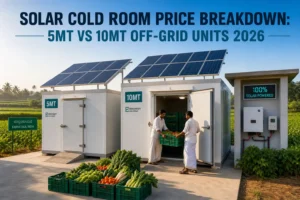
For Indian farmers and small-scale distributors, grid-dependent cooling is often a gamble against power cuts and rising tariffs. In 2026, the shift toward farm-gate cooling has made micro-units the gold standard for post-harvest loss reduction. But the big question remains: what is the actual solar cold room price 2026? This guide breaks down the costs, specifications, and ROI for 5MT and 10MT off-grid units to help you choose the most profitable asset for your harvest.
Factors Influencing Solar Cold Room Prices in 2026
When budgeting for a micro-cold storage unit, it is important to understand that you aren’t just buying a “box.” You are investing in a standalone power plant and a high-efficiency thermal warehouse. The solar cold room price 2026 is primarily driven by three core components: the solar PV array, the energy storage system, and the quality of the thermal envelope.
The Solar PV array must be sized correctly to ensure the compressor runs during peak sunlight while simultaneously charging the batteries. If the array is undersized, the system will fail during cloudy days. Secondly, the PUF panel density (usually 40-42 kg/m³) and thickness (100mm to 120mm) determine how long the room can hold its temperature. Cheaper, thinner panels might lower the initial cost, but they lead to higher energy consumption and faster battery depletion, which eventually costs you more in repairs. For a deeper look at high-efficiency setups, check out our guide on the Sustainable Cold Chain 2026.
LFP vs. Lead-Acid: The 2026 Battery Standard
The most significant variable in your solar cold storage battery cost is the chemistry you choose. In 2026, Lead-Acid batteries have largely been phased out for industrial use in India. While they are cheaper upfront, their short lifespan in high-heat environments makes them a poor investment for cold storage.
Today, Lithium Ferro Phosphate (LFP) is the industry standard. LFP batteries offer a much higher cycle life often lasting 10 years or more compared to the 2-3 years provided by Lead-Acid. Furthermore, LFP allows for a deeper “depth of discharge,” meaning you can use more of the stored energy without damaging the battery. When calculating your total investment, choosing LFP reduces your long-term maintenance costs and ensures your cooling remains stable throughout the night.
Key Insight: While LFP batteries increase the initial price by roughly 20-25%, their longevity and efficiency mean they actually pay for themselves twice over compared to cheaper alternatives.
5MT Solar Cold Room: Price Breakdown & Specs
The 5MT (Metric Tonne) solar cold room is currently the most popular “entry-level” investment for individual farmers and small collection centers. In 2026, these units have evolved into highly efficient, portable units that can be deployed at the farm-gate within days. If you are looking to store high-value perishables like berries, flowers, or exotic vegetables, this size provides the perfect balance between storage capacity and solar power efficiency.
The 5MT solar cold room price in India typically ranges between ₹12 Lakh and ₹18 Lakh, depending on the level of technical sophistication. While you might find cheaper non-branded options, a professional-grade unit in this price bracket usually includes a high-efficiency 5.5kWp solar array and advanced LFP battery storage to ensure 24/7 operation. This price also covers the pre-fabricated structure and the technical assembly at your site.
What’s Included in a Standard 5MT Unit?
When you receive a 5MT solar cold room price in India quotation, it should include a detailed breakdown of the following technical specifications to be considered “bankable”:
- Storage Capacity: Approximately 750–800 cubic feet of internal space.
- Solar PV Array: 5kWp to 7kWp monocrystalline panels.
- Insulation: 100mm to 120mm high-density PUF panels for maximum thermal retention.
- Cooling Unit: A 2.5 TR high-efficiency compressor with Variable Frequency Drive (VFD).
- Battery Backup: LFP battery bank providing 24–30 hours of autonomy.
- Smart Features: IoT-enabled remote monitoring for temperature and battery health.
Average cost of a 5MT unit: In the 2026 market, a fully-featured, off-grid 5MT solar cold room typically averages around ₹15 Lakh, excluding government subsidies.
10MT Solar Cold Room: Cost of Scaling Up
For aggregators, Farmer Producer Organizations (FPOs), or larger organic estates, the 5MT unit might feel a bit tight. This is where the 10MT off-grid cold storage cost becomes a critical part of the conversation. In 2026, scaling up to a 10MT capacity is often the preferred choice for those handling higher daily volumes or diverse harvests, as it offers a more robust platform for multi-commodity storage.
A common misconception is that a 10MT unit will cost twice as much as a 5MT unit. Fortunately, this isn’t the case due to the “Efficiency of Scale.” While you are doubling the storage volume, you aren’t doubling the surface area of the panels or the complexity of the internal wiring. The structure itself becomes more cost-effective per cubic meter, and the high-capacity solar cooling machinery used in these units offers better performance ratios than smaller compressors.
In the current 2026 market, a professional 10MT solar cold room typically ranges between ₹20 Lakh and ₹28 Lakh.
Why the 10MT Unit is a Smart Upgrade
The jump from 5MT to 10MT provides significant operational advantages:
- Reduced Power Intensity: A 10MT room holds its temperature better because the larger volume of cold air acts as a natural “thermal buffer,” putting less strain on the battery bank.
- Solar Efficiency: You typically move to a 10kWp or 12kWp solar array, allowing for faster battery charging even on partially cloudy days.
- Versatile Loading: With 10MT, you have the space to create separate partitions for different commodities.
5MT vs. 10MT: Head-to-Head Comparison
Choosing between a 5MT and a 10MT unit is one of the most critical decisions in your procurement process. While price is a concern, a true comparison looks at technical output versus your daily operational needs.
| Feature | 5MT Solar Cold Room | 10MT Solar Cold Room |
| Storage Volume | ~750 – 800 cu. ft. | ~1500 – 1650 cu. ft. |
| Solar Capacity | 5kWp – 7kWp | 10kWp – 12kWp |
| Avg. Price (2026) | ₹15 Lakh | ₹24 Lakh |
| Battery (LFP) | ~15kWh – 20kWh | ~30kWh – 40kWh |
| Daily Throughput | ~500kg – 800kg | ~1000kg – 1500kg |
Which Size Fits Your Crop Volume?
Finding the right fit depends on your landholding. As a general micro cold storage capacity guide, the 5MT unit is the ideal solution for small farmers with 2 to 3 acres of high-value crops like strawberries, exotic flowers, or mushrooms. Because these crops are often lightweight but highly sensitive, the smaller footprint is easier to manage.
For vegetable farmers or FPOs managing 5 to 10 acres, the 10MT unit is almost always the better choice. Commodities like carrots, leafy greens, or ginger have a higher bulk density and require more space for airflow. If you attempt to “over-pack” a 5MT unit, you risk poor circulation and uneven cooling, which drastically reduces vegetable shelf-life. Horticulture storage for larger volumes requires the extra “breathing room” that a 10MT unit provides.
Subsidies & Financial Support for Micro Units
One of the biggest hurdles to adopting solar is the upfront cost. However, in 2026, the net solar cold room price 2026 is significantly reduced through government support. In general areas like the plains of Karnataka, the subsidy rate typically covers 35% of the total project cost. For projects in hilly or scheduled areas, this can jump to 50%.
For a ₹15 Lakh 5MT unit, you could receive a reimbursement of over ₹5 Lakh, bringing your effective investment down to ₹10 Lakh. To ensure your application is successful, it is vital to follow the correct NHB subsidy process in Karnataka.
Specific Grants for Solar Integration
- NHB Add-ons: Claim up to 100% of the cost for Solar PV panels, capped at ₹35 Lakhs.
- PM-KUSUM Scheme: Helps farmers set up standalone solar power units with a combined subsidy of up to 60%.
- NABARD & PMKSY: Provides 35% to 50% subsidy for integrated cold chain projects.
The Zero-OPEX Benefit: Calculating Your Payback Period
In the refrigeration industry, we call this the Zero-OPEX model. While a traditional cold room is a constant drain on your cash flow, a solar-powered unit turns your energy into a fixed asset. When you look at the Solar cold room ROI, factor in electricity savings, the reduction in post-harvest loss, and the ability to sell when market prices peak.
In 2026, micro-storage allows you to wait for price fluctuations that often result in a 20% to 30% revenue increase. If you are looking to scale even further, compare these micro-unit numbers with our ROI Analysis for 5000 MT Cold Stores.
A Typical 3.5-Year Payback Scenario
For a 5MT unit costing a net ₹10 Lakh after subsidy:
- Annual Electricity Savings: ~₹1.2 Lakh.
- Loss Reduction: Saving 15% of high-value crops adds ₹1.5 Lakh to ₹2 Lakh in revenue.
- Market Timing: Adds another ₹1 Lakh annually.
With a total benefit of roughly ₹4 Lakh per year, the unit reaches its “break-even” point in just 2.5 to 3.5 years. After that, every kilogram of produce saved is pure profit.
Common Mistakes When Buying Small Solar Units
Many first-time investors rush for the lowest quote, leading to sustainable cold storage mistakes. A common trap is an undersized solar array. If your panels can’t charge the batteries during a 6-hour window of peak sunlight, the system will fail during cloudy periods.
Another massive energy drain comes from poor door seals. This is why we emphasize that high-quality Cold Room Doors are just as important as the solar panels. A door with a weak gasket allows heat to enter, forcing your compressor to work twice as hard and draining your battery backup prematurely.
FAQs: Choosing Your Off-Grid Cooling Solution
How does the system perform during the monsoon?
A professional system in 2026 typically includes enough battery capacity for 24 to 36 hours of autonomy without any sunlight.
What are the typical maintenance costs?
Maintenance is mostly limited to cleaning solar panels and checking compressor gas levels annually. For long-term reliability, ensure you have a professional plan for commercial cold room repair and maintenance.
Can I move my 5MT unit?
Yes. Most are built on a “skid-mounted” platform, making them highly portable.
Is remote monitoring necessary?
In 2026, it’s a safeguard. A mobile app lets you check the internal temperature and battery health in real-time, preventing spoilage.
Practical Steps to Request a Custom Quote
- Detailed Load Calculation: Calculate exactly how many kilograms of produce you will load every day.
- Site Assessment: Ensure your rooftop or ground area is free from shadows between 9 AM and 4 PM.
- Verify Subsidy Eligibility: Confirm which state or central schemes you qualify for before getting the final quote.
Key Insight: A professional quotation should be more than just a price; it should be a technical blueprint that proves the system can maintain your required temperatures even during the hottest months of the year.
Visit our Google My Business listing to see our recent custom installations! Call Cold Smith Enterprises Today: +91-9632758132