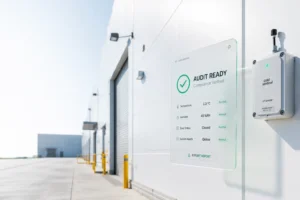
Operating a cold storage facility in 2026 is no longer just about keeping things cold; it’s about proving you’re doing it right. With FSSAI moving to a digital-first model, many operators are feeling the pressure of rules that weren’t there a few years ago. Missing an update isn’t just a small mistake it can halt your entire operation. This guide breaks down the new FSSAI 2026 guidelines for cold storage, giving you the exact steps needed to stay compliant and keep your business running smoothly.
The End of Renewals: How FSSAI Perpetual Licensing Works
For a long time, the five-year renewal cycle was a major headache for cold chain businesses. You had to track dates, resubmit paperwork, and pay fees just to keep your doors open. In a significant shift, FSSAI has introduced the FSSAI perpetual license cold storage model. Now, once your license is approved, it stays active for a lifetime. You don’t have to worry about an expiration date hanging over your head anymore.
However, “perpetual” does not mean “set and forget.” To keep this lifetime validity, you must file your annual returns on the FoSCoS portal every year before the May 31st deadline. If you skip this, the system flags your license immediately for suspension. It is a move away from periodic fees toward constant, ongoing accountability.
Under the new rules, if your turnover or business type changes, you must update the portal immediately through a “Modification of License.” The focus has shifted from paying for a piece of paper to proving your active operations through consistent data entry. For a broader look at how this fits into your general safety goals, you can review our guide on 2026 Cold Storage Compliance Standards.
Key Insight: The perpetual license is a reward for transparency. By removing the renewal fee, FSSAI expects you to be much more diligent with your annual reporting and data accuracy.
2026 Turnover Revisions: Central vs. State License Migration
The most significant operational shift this year is the change in turnover thresholds. As of April 1, 2026, FSSAI has raised the bar for both State and Central licenses to match the growing scale of the Indian cold chain. For many, this means a mandatory transition. If your annual turnover has recently crossed the new ₹50 Crore mark, your existing State License is no longer enough. You are now required to migrate to a Central License to stay legal.
This migration isn’t just about money; it is also tied to your storage capacity. Understanding where you fall in these new brackets is critical because operating under the wrong tier can lead to an automatic “deemed suspension.”
| Feature | State License (2026) | Central License (2026) |
| Annual Turnover | ₹1.5 Crore to ₹50 Crore | Above ₹50 Crore |
| Cold Storage Capacity | Up to 10,000 MT | Above 10,000 MT |
| Scope of Operation | Within one State | Multi-state / Pan-India |
| Import / Export | Not permitted | Mandatory for any Ex-Im |
| Annual Fee | ₹5,000 | ₹7,500 |
The FoSCoS portal updates 2026 have made the migration process easier. You don’t need to cancel your old license; instead, you apply for a “Modification of License.” This lets you keep your 14-digit FSSAI number while upgrading your status. This is helpful for established businesses that have their license numbers printed on packaging or marketing materials. If you are setting up a new facility, working with experts in cold storage installation in Bangalore can help ensure your documentation is ready for these filings from day one.
Risk-Based Inspections: The New System-Driven Audit Model
Gone are the days when an inspector would show up based on a random schedule. Under the FSSAI risk-based inspection framework, audits are now triggered by a system-driven algorithm. The FSSAI backend evaluates every facility based on a “Compliance Score.” If your facility has a history of clean audits and timely filings, you will see inspectors much less often. If you handle high-risk food or have had past violations, expect more frequent visits.
This system is powered by the FosCoris app. Instead of using a clipboard, inspectors upload photos, temperature logs, and hygiene observations directly to the cloud in real-time. This means your audit result is generated almost instantly. Facilities storing meat, poultry, dairy, or seafood are automatically placed in the “high-risk” bracket, requiring tighter oversight.
Key Insight: Your digital footprint is your reputation. Consistently clean data logs and a history of zero violations are the best ways to keep the inspectors away and your compliance costs low.
Ripening Chamber Specifics: Prohibited Agents & Monitoring
Ripening chamber operators face the strictest scrutiny in 2026. FSSAI issued a nationwide advisory targeting illegal practices that pose health risks. The most critical point in the FSSAI fruit ripening guidelines is the total ban on Calcium Carbide (often called “masala”). This chemical is hazardous and can lead to legal prosecution if found on your premises.
Inspectors now use “strip paper tests” to detect trace amounts of acetylene gas. Furthermore, while Ethephon is common, directly dipping fruits into Ethephon solutions is a major violation. According to 2026 standards, ethylene gas is the only permitted ripening agent, and it must be used in its gaseous form avoiding any direct contact between the fruit and the agent.
To stay on the right side of the law, your fruit ripening chamber in Bangalore must be equipped with precise ethylene generators and sensors. You must also keep detailed “Ripening Agent Logs” that document the source and application method of the gas used.
Step-by-Step: How to Migrate Your License on FoSCoS
The transition to a perpetual license happens entirely through the Food Safety Compliance System (FoSCoS) portal. Here is a simple guide to migrating your license:
- Login: Use your existing credentials on the FoSCoS website.
- Select ‘Modification’: Don’t click ‘Renewal.’ Select the option to modify your license to convert to “Perpetual” status.
- Update Turnover: Input your audited figures. If you’ve crossed ₹50 Crore, the system will prompt a shift to a Central license.
- Upload Documents: Attach your latest FSMS plan and proof of premises in PDF format.
- Digital Signature (DSC): For Central licenses, a Class 3 Digital Signature is now mandatory for submission.
- Fee Payment: Pay the one-time modification fee.
Penalties and Enforcement: The Cost of Non-Compliance
In 2026, FSSAI has moved to a “proactive” model. A single missed deadline can lead to a “deemed suspension,” locking you out of your business overnight.
The most common trap is the annual return late fee. You must file your Form D1 by May 31st each year. The penalty is a fixed ₹100 per day, and the system is automated the fine starts ticking at midnight on the deadline.
If an inspector finds critical FSMS gaps, they can issue an immediate suspension order through the mobile app. If a license is cancelled for safety violations, the operator is barred from applying for a new license for the same premises for up to two years. Keeping your infrastructure updated via a trusted manufacturer for cold room in Bangalore is your best defense.
Mandatory Digital Records: Schedule 4 Part II Compliance
Hand-written temperature logs are no longer enough. The 2026 amendments focus on the “integrity” of your records. FSSAI expects you to maintain digital, non-editable records that capture temperature and humidity levels at Critical Control Points (CCP).
This standard is known as ALCOA+ (Attributable, Legible, Contemporaneous, Original, and Accurate). These logs must be time-stamped and protected from back-dated entries. To keep these records accurate, you need regular sensor testing and a proactive commercial cold room repair schedule.
Sustainable Compliance: Connecting FSSAI with NHB Benefits
Meeting FSSAI standards is now a requirement for getting government money. The National Horticulture Board (NHB) requires proof of compliant FSSAI registration before approving any NHB subsidy process.
The government is specifically pushing for sustainable cold chain infrastructure. This includes:
- Low GWP refrigerants.
- Energy-efficient automation.
- Fire-rated insulation.
By merging your FSSAI hygiene protocols with a green design, you qualify for subsidies that can cover 35% to 50% of your project costs.
Expert Q&A: Navigating the 2026 FSSAI Transition
-
Is the FSSAI license really for a lifetime now?
Yes, provided you pay your annual fees and file your returns. No more full renewal applications every five years.
-
Can I still use manual logbooks for temperature tracking?
No. Auditors in 2026 will not accept manual logs as primary evidence. You need digital, time-stamped records.
-
What happens if I miss the May 31st deadline?
The system applies a ₹100 per day penalty automatically. Your license status may also be moved to “suspended.”
-
Does the ₹50 Crore limit apply to me immediately?
Yes. If your turnover has crossed this mark, you should apply for a license modification now to avoid being flagged by GST-integrated data checks.
Visit our Google My Business listing to see our recent custom installations! Call Cold Smith Enterprises Today: +91-9632758132