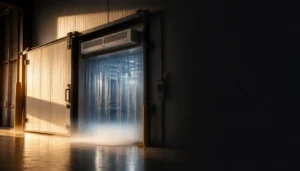
Every time a worker opens a cold storage door to move pallets, a major spike in operating costs occurs. A loading bay door left wide open during a busy shift acts as a constant drain on your utility budget. This problem stems from an entryway penalty known as cold room door opening heat load infiltration. When warm outside drafts breach your loading docks, your refrigeration equipment has to work overtime to clear the incoming heat. This guide breaks down how this continuous air exchange lowers system efficiency and details the simple, practical fixes you can use to protect your thermal boundaries.
The Gravity Draft Effect: How Air Moves When a Door Opens
To control entryway energy losses, it helps to understand how air behaves when your facility’s physical doors slide open. Warm air and cold air have completely different densities. Because cold air is heavy and dense, it naturally drops straight down toward the ground. The moment your cold store door opens, this heavy chilled air pours out across the floor like water breaching a dam.
This escaping cold air creates an immediate pressure drop inside the room. To equalize this pressure, lighter, warm outside air gets sucked in rapidly through the top half of the open door frame. This continuous, circular air movement creates an ongoing industrial refrigeration air exchange loop.
If your warehouse loading docks experience high air changes per hour (ACH) due to constant forklift traffic, this draft can replace a massive percentage of your chilled room air with hot, ambient air in just a few minutes. This ongoing movement forces your cooling system to run continuously just to bring the room back down to temperature, leading to heavy door cycle efficiency loss.
Key Takeaway: Open doors trigger a natural gravity draft that dumps cold air along the floor and pulls hot air in through the ceiling. Minimizing the open time of your door cycles is the fastest way to stop this constant energy loss.
Sensible vs. Latent Heat: Why Outside Moisture is Your True Enemy
When an outside draft enters your facility, it carries two distinct types of heat energy. The first is sensible heat, which is the physical temperature rise you can feel on your skin. While sensible heat forces your compressor to work harder, it is actually the easier of the two components to manage.
The real danger to your monthly operating budget is latent heat. Latent heat is the thermal energy trapped inside invisible water vapor. When warm, humid air rushes into your cold storage space, it triggers serious cold storage humidity management issues. As this moist air hits your freezing evaporator coils, the water vapor condenses instantly into liquid water and freezes into solid ice.
[The Latent Heat Freeze Loop]
Humid Air Enters ──> Vapor Condenses on Coils ──> Solid Ice Blocks Airflow ──> System Power Consumption Spikes
This rapid frost accumulation creates a thick, insulating blanket over your cooling fins, choking off normal airflow and making it incredibly difficult for the system to absorb room heat. To clear this ice block, your refrigeration system is forced to shut down its cooling cycle and run frequent, power-hungry defrost heaters. This constant cycling creates a massive, ongoing drain on your system’s overall efficiency.
The Costly Aftereffects: How Persistent Air Infiltration Damages Your Facility
Leaving entryway air leaks unmanaged does far more than just raise your electricity bills. Over time, persistent moisture spikes begin to cause serious physical damage to the interior structure of your warehouse. When warm air continuously leaks inside, the moisture settles on your storage racks, ceiling joints, and products.
In a freezer, this constant humidity turns into a layer of slick, hard ice directly on the warehouse floor, presenting a serious workplace safety risk for forklift operators. Furthermore, when moisture constantly collects around your ceiling panels, it can seep directly into your wall joints. This trapped water creates localized insulation breakdown, destroys your vapor barrier, and causes the internal steel frames to slowly rust from the inside out.
Allowing these entry leaks to continue forces your equipment into an ongoing cycle of high stress. Your compressor is pushed to run continuously to fight the incoming warmth, causing premature wear on internal valves. To see how these entryway air leaks add up alongside your building’s overall wall insulation parameters, check out our baseline guide: A Simple Guide to Cold Storage Heat Load Calculations.
Key Takeaway: Unchecked air infiltration causes heavy ice buildup on floors and dangerous moisture leaks behind your wall panels. Fixing entryway drafts early protects your staff from accidents and saves your building frame from long-term rust damage.
Practical Upgrades: High-Efficiency Barriers That Block Incoming Air
To stop the gravity draft effect from draining your budget, you must install physical barriers at your entryway thresholds. These upgrades work to break up the convective airflow loop, keeping your chilled air inside the room even when the main solid door is open for loading.
Depending on your daily loading volumes and forklift traffic, certain barrier systems will offer a much better return on investment for your facility layout:
| Entryway Barrier Type | Best Used For | Air Blocking Efficiency | Operational Trade-Off |
| PVC Strip Curtains | Low-to-medium traffic, manual pallet jacks | 50% – 60% obstruction | Strips get dirty over time and can scratch plastic product packaging. |
| High-Velocity Air Curtains | High-volume forklift bays, constant traffic | 75% – 85% obstruction | Requires correct nozzle alignment and adds minor fan motor electrical load. |
| Fast-Acting Roll-Up Doors | Automated logistics centers, rapid transitions | 90%+ obstruction | Higher upfront installation cost and requires ongoing safety sensor checks. |
If you run a high-traffic loading bay, relying on manual doors or slow sliding tracks leads to a major door cycle efficiency loss. For these setups, combining a high-velocity air curtain with a fast-acting roll-up door is the ideal choice. The automated door opens and closes in just a few seconds, while the downward blast of air creates an invisible wall that blocks incoming warmth.
For smaller walk-in chillers, optimizing your pvc strip curtain efficiency for walk in chillers is a simple, low-cost fix. Ensuring the clear vinyl strips overlap by at least 25% prevents ambient drafts from slipping through the gaps between the panels.
The Diagnostic Checklist: How to Spot Failing Door Seals and Frame Leaks
You do not need expensive engineering tools to find out if your doorway is leaking energy. A simple physical walk-around of your entryway can quickly reveal if your facility is suffering from unmanaged air infiltration. Checking these boundaries regularly helps you catch small air gaps before they turn into major operational headaches.
When conducting your weekly facility inspection, look for these four common warning signs:
- Ice Around the Frame: If you see frost or ice forming directly on the inside door frame, warm outside humidity is definitely slipping through the gap and freezing instantly.
- Whistling Air Noises: A closed cold store door should be completely silent. If you hear a soft whistling or hissing sound, air is actively rushing through a broken seal.
- Brittle Rubber Seals: Feel the rubber along your door gasket sealing tracks. Over time, constant temperature changes make this rubber hard, brittle, and cracked, destroying its ability to cushion and seal.
- Physical Alignment Shifts: Look at the track alignment. Heavy forklift bumps can easily bend metal brackets or push heavy sliding doors slightly off their tracks, leaving a permanent gap at the top or bottom.
Ignoring these small structural issues will quickly lead to frosted evaporator coils and a dangerous jump in your monthly power bills. If you notice ice patches on your door frame or find that your sliding tracks are sticking, scheduling an inspection with an expert team for Commercial Cold Room Repair and Maintenance in Bangalore is the safest way to reseal your thermal boundaries and preserve your equipment life.
Key Takeaway: Regular visual checks on your entryway rubber seals and metal tracks prevent minor air leaks from turning into massive compressor breakdowns. Fixing a worn gasket early keeps your energy costs low and your room temperatures stable.
Frequently Asked Questions About Cold Room Air Leaks
Why is ice forming directly around my cold room door frame?
Ice forms on your door frame because warm, humid outside air is actively leaking through a gap in your rubber seals. When that outside moisture hits the freezing temperatures inside your cold room, the water vapor condenses and turns instantly into solid ice. This is a clear sign that your gaskets are worn out or your door tracks are misaligned.
Do air curtains completely stop hot air from entering?
Air curtains are highly effective, but they do not block 100% of outside air. A properly installed, high-velocity air curtain blocks roughly 75% to 85% of incoming drafts by creating an invisible wall of moving air. To get the best results, they should always be combined with fast-acting automated doors.
How often should industrial warehouse door seals be replaced?
Under normal warehouse conditions, door seals should be checked monthly and replaced every 12 to 18 months. However, in high-traffic loading docks where forklifts move constantly, heavy wear and tear can cause rubber gaskets to split or lose their flexibility much faster.
Visit our Google My Business listing to see our recent custom installations! Call Cold Smith Enterprises Today: +91-9632758132