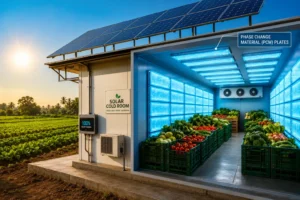
In 2026, the real cost of solar-powered refrigeration isn’t the sun it’s the storage. While Lithium (LFP) batteries have been the go-to, their high replacement costs and sensitivity to heat are pushing farmers toward thermal energy storage for cold rooms.
By using Phase Change Materials (PCM), you can “store the cold” directly in the structure of your facility. This guide explains how PCM technology for cold storage allows for battery-less or hybrid cooling, slashing your initial investment while keeping your produce fresh 24/7.
The Science of “Cold Batteries”: What is PCM Technology?
Think of PCM as a “thermal battery.” A chemical battery stores electricity to run a machine later, but PCM stores the cooling effect itself. Essentially, these are industrial-grade ice packs engineered to freeze and melt at specific temperatures like +2°C for vegetables or -23°C for frozen meat.
By adding these materials to your cold room’s ceiling or walls, the room gains thermal inertia. This lets the facility hold its temperature for hours, even during power cuts or after sunset, without needing a massive, expensive battery bank. For more on how this fits into a broader green strategy, see our guide on the Sustainable Cold Chain 2026.
How Latent Heat Storage Works in 2026
The secret lies in “latent heat.” Unlike standard materials that change temperature gradually, PCMs stay at a constant temperature while they melt or freeze. This is called isothermal cooling.
- Charging (Day): When your solar panels are peaking, the system freezes the PCM (crystallization phase). It’s storing “cold energy.”
- Discharging (Night): When the sun goes down, the PCM melts slowly, absorbing any heat that enters the room. Because it melts at a fixed eutectic point, the room temperature stays perfectly steady.
Key Insight: PCM doesn’t just hold cold air; it actively fights heat. This passive process can keep a well-insulated room within a 1°C range for up to 24 hours without the compressor running.
PCM vs. Chemical Batteries: A 2026 Reality Check
Lithium Ferro Phosphate (LFP) is currently the best chemical storage, but it has a “cycle life.” Most LFP banks need replacement every 8–10 years. PCM, however, is virtually permanent. It relies on a physical change, not a chemical one, so it can freeze and thaw for decades without losing efficiency.
The solar cold storage battery cost is usually the biggest hurdle for off-grid setups. Swapping a large chunk of your battery bank for PCM plates lowers your upfront CapEx. Plus, PCM doesn’t need a complex Battery Management System (BMS) or fire suppression, making it a “set-and-forget” win for rural farms.
Solving the “Heat Sensitivity” Problem
Chemical batteries hate the heat. In tropical climates, LFP batteries can degrade quickly if the battery room isn’t air-conditioned. It’s ironic: you’re using energy to cool the equipment that’s supposed to be saving energy.
PCM technology stays inside the insulated cold room. It’s naturally protected and doesn’t care how hot it is outside. This makes battery-less solar cold storage far more reliable in hot regions where sensitive chemicals might overheat or fail.
Can You Go 100% Battery-Less with Solar Cold Storage?
Going 100% battery-less is possible but tricky. You still need a tiny amount of power for the “brains” the fans, sensors, and controllers.
The most popular 2026 model is Hybrid Storage. Instead of a massive LFP bank to run the heavy compressor all night, you use a small battery for the 50-watt fans and let the PCM do the cooling. This significantly drops the solar cold room price 2026 because you aren’t over-buying battery capacity.
The Power of Peak Shaving
Hybrid systems use peak shaving. From 10 AM to 4 PM, your solar panels run the compressor at full tilt to “over-cool” the PCM. You’re essentially shifting your night-time cooling work to the day. Once the sun sets, the compressor rests, the PCM takes over, and your small battery keeps the air moving.
The Economics of Thermal Energy Storage
In 2026, the phase change material cooling cost is a strategic move. It’s about load shifting generating your cooling when solar power is free and using it when electricity would be expensive.
This creates Zero-OPEX cooling. For a small farmer, this is the difference between profit and a mountain of utility bills. For larger operations, the efficiencies are even bigger, as shown in our ROI Analysis for 5000 MT.
Long-Term Value vs. Upfront Cost
PCM offers a “flat” depreciation curve. Unlike batteries that lose value with every charge, PCM stays stable. A typical 10MT cold room using PCM can cut grid dependence by 50%. Over a decade, the savings on power and battery maintenance often pay for the PCM tech three times over.
Best Crops for PCM-Integrated Cooling
Standard compressors often have a “sawtooth” temperature profile the temperature bounces up and down as the machine cycles. PCM provides a rock-steady environment, which is vital for horticulture storage.
- Berries & Leafy Greens: Highly sensitive to “chilling injury” or wilting. PCM keeps them at a precise, unwavering temp.
- Florals: Roses and orchids lose value if temperatures fluctuate even slightly.
- Pharma: Vaccines must stay within a strict 2°C to 8°C range; PCM acts as a fail-safe backup.
Key Insight: For high-value crops, temperature stability is the difference between a premium price and a total loss.
Common Mistakes in Implementation
PCM isn’t a magic fix; it’s physics. Most sustainable cold storage mistakes happen when the material doesn’t match the goal.
- Wrong Melting Point: If you use a PCM that melts at 0°C for a room that needs to stay at 8°C, it will never “charge.”
- Poor Airflow: PCM plates need air to move over them. If you stack crates right against the panels, the cold can’t escape.
- Leaky Doors: Even the best thermal battery can’t fight a bad door seal. High-quality cold room doors are a must.
FAQs: Thermal Energy Storage for Cold Rooms
Can I retrofit PCM into my existing room?
Yes. Most solutions are “plug-and-play” plates that bolt onto the ceiling or walls of your current facility.
Does it work in cloudy weather?
Yes. As long as the compressor runs for a few hours during the day, it will charge the PCM. In fact, PCM is more efficient in cooler, cloudy months because there’s less heat leak.
What is the maintenance?
Zero. No moving parts, no chemicals to top up. Just keep the plates clean and the airflow clear.
Are there subsidies?
In 2026, the Indian government heavily backs “green cooling.” PCM projects often qualify for higher grants under the NHB subsidy process in Karnataka.
Next Steps: Moving to Thermal Storage
Don’t just hang up PCM plates and hope for the best. You need a technical blueprint. Start with an audit of your insulation and solar capacity.
When you get a solar cold room quotation, ask for the “Thermal Storage Option.” A pro vendor will calculate exactly how much PCM you need based on your specific crop and daily loading. By aligning your tech with NHB subsidy rules early, you can slash your out-of-pocket costs and future-proof your business.
Key Insight: PCM integration is a precision task. Start with an audit, get a technical quote, and secure your subsidies before you begin.
Visit our Google My Business listing to see our recent custom installations! Call Cold Smith Enterprises Today: +91-9632758132