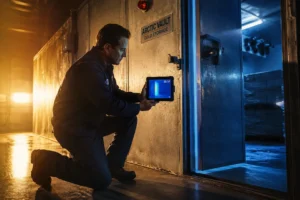
 High electricity bills are the silent profit-killers of the cold chain industry. In 2026, with grid tariffs climbing across India, many operators find that nearly 30% of their revenue is swallowed by power costs alone. You don’t always need a total system overhaul to fix this. By performing a targeted audit, you can reduce cold room electricity consumption significantly. This guide provides 10 practical hacks from mechanical tuning to simple thermal tests designed to put that 40% of wasted energy back into your pocket.
The 5-Minute Energy Audit: Identifying the “Hidden Leaks”
Most energy wastage is invisible. Heat ingress and air infiltration happen silently, forcing your compressor to work overtime. Before calling in a technician, use a simplified cold storage energy audit checklist to spot efficiency gaps. Walk around your unit and look for signs of “sweating” on the panels or ice buildup near the door. These are clear signs of thermal bridging where heat is literally “bridging” the gap from the outside into your cold space.
Hack 1: The Dollar-Bill Gasket Test
One of the most effective cold room power saving tips requires nothing more than a currency note. Open your door, place a ₹500 note across the gasket, and close it. If you can pull the note out easily without resistance, your gasket seal is failing.
An air-tight seal is your first line of defense. If the gasket is brittle or flat, it lets a constant stream of warm, moist air into the room. This raises the temperature and makes the evaporator coils frost up faster. For more on maintaining a perfect seal, see our Cold Room Doors Guide.
Hack 2: High-Speed Strip Curtains and Air Barriers
Every time the door opens, you lose money. Up to 80% of heat gain in a busy facility occurs during loading. Lowering industrial refrigeration power consumption starts with PVC strip curtains. These act as a secondary barrier, stopping the cold air from rushing out and the warm air from rushing in.
If your curtains are cracked or missing strips, you are losing money every minute the door is open. Replacing them is a cheap fix that ensures the “recovery time” how long it takes the room to get back to its set temperature is cut in half.
Mechanical Tuning: Optimizing the Heart of the System
Once you’ve sealed the “box,” look at the machinery. Many older systems are either “on” or “off,” which is an inefficient way to cool. Modern energy efficient refrigeration systems rely on precision tuning so the compressor, the biggest power consumer, runs only when necessary and at the best speeds.
Hack 3: Installing Variable Frequency Drives (VFDs)
In 2026, a VFD for cold storage is a must-have for lowering costs. Standard compressors hit a massive energy surge every time they start up. A VFD provides “soft start” capabilities and, more importantly, motor speed control.
Instead of the compressor running at 100% to drop the temperature by just half a degree, the VFD lets it run at a lower, steady speed. This prevents the “start-stop” cycle that wears out parts and spikes bills. This can improve your system’s Coefficient of Performance (COP) by up to 25% during low-load periods like nighttime.
Hack 4: Fine-Tuning the Temperature Differential
Many operators set a very tight “differential” on their thermostat. If your target is 4°C and your differential is 0.5°C, the compressor kicks in the second the room hits 4.5°C. This leads to constant compressor cycling and wasted power.
Widening that differential to 2.0°C or 2.5°C can lead to big savings without hurting your produce. It lets the room’s natural isothermal stability do the work, allowing the temperature to drift slightly before the heavy machinery needs to start.
Airflow & Evaporator Maintenance: The Breath of the Room
A perfectly tuned compressor will still struggle if the air it cools cannot move. Proper airflow management ensures the room cools evenly without “hot spots.” To reduce cold room electricity consumption, your evaporator unit must be free of grime and blockages.
Hack 5: The “6-Inch Rule” for Crate Placement
One of the simplest cold storage energy saving hacks is just moving your crates. Stacking them directly against walls or up to the ceiling creates “short-circuiting,” where cold air hits an obstruction and bounces right back to the intake sensor.
Follow the 6-inch rule: leave six inches of space between the walls and your pallets, and 18 inches below the evaporator. This lets air circulate behind and under the produce. The room reaches the set temperature faster, and the compressor shuts off sooner.
Hack 6: Chemical Cleaning of Condenser Fins
Your condenser dumps the heat from inside the room to the outside. Over time, these fins collect dust and scale, which acts like a blanket, trapping heat.
As part of your commercial cold storage operating costs audit, check the outdoor unit. If the fins are dirty, the head pressure rises, and power draw spikes. A professional cleaning can restore efficiency instantly. This preventive maintenance keeps your system from “choking” on its own heat.
Smart Defrosting and Internal Load Management
Inside your facility, a “war” often happens: the evaporator is trying to cool while defrost heaters and old lights pump heat back in. These hacks help end that conflict.
Hack 7: Demand-Defrost vs. Timed-Defrost
Ice on evaporator coils is normal, but how you remove it affects lowering industrial refrigeration power consumption. Old systems use “Timed Defrost,” which turns on heaters every few hours, even if there’s no ice. This adds unnecessary heat to the room.
In 2026, the best practice is “Demand Defrost.” By using ice buildup sensors, the system only defrosts when it actually needs to. This saves the energy used for the heaters and the energy the compressor would need to cool the room back down afterward.
Hack 8: The Lighting & Sensor Upgrade
Old bulbs are essentially heaters that happen to produce light. Every watt of heat they emit must be removed by the refrigeration system.
Switching to IP65 LED lighting is a win-win: they produce almost no heat and last longer in the cold. Adding motion sensors ensures lights are only on when someone is in the room. It stops the common mistake of leaving lights on overnight.
Operational Strategy: Timing the Load
Human behavior is often the biggest factor in your bill. In 2026, smart operators shift heavy tasks to times when the environment is on their side.
Hack 9: The “Pre-Dawn” Loading Strategy
Produce fresh from the field carries field heat. If you load a room in the afternoon, the compressor has to fight both the high ambient temperature and the heat of the crop.
By shifting to a “Pre-Dawn” strategy loading between 4 AM and 8 AM you use natural ambient cooling. The produce and the outside air are at their coolest, reducing the energy needed for the initial pull-down by up to 15%.
Hack 10: IoT-Based Energy Monitoring
You can’t fix what you can’t see. A modern cold storage energy audit checklist should include IoT energy monitors. These show you exactly when your power consumption spikes.
Maybe your system is running too hard when the room is empty. This data allows for peak shaving, where you adjust operations to avoid high-tariff periods. Having these stats on your phone makes horticulture storage efficiency a daily habit rather than a monthly surprise.
Next Steps: When Maintenance Isn’t Enough
If your facility is over a decade old, simple tuning might not be enough to meet sustainable cold chain 2026 standards. You might need to look at deeper technology upgrades.
One of the best moves is switching from chemical batteries to PCM technology. As we explained in our guide on how PCM replaces batteries, this allows you to store cooling energy passively and slashes compressor load during the day.
While these upgrades have an upfront cost, NHB subsidies can cover a large portion of the bill. These grants are there to help you transition to greener, cheaper tech. If your bills are still high after trying these hacks, it’s time to stop patching the old and start building for the future.
Key Insight: Maintenance fixes today’s costs; technology upgrades fix your future. If the hacks aren’t enough, it’s time to talk to an expert about a 2026 retrofit.
Visit our Google My Business listing to see our recent custom installations! Call Cold Smith Enterprises Today: +91-9632758132