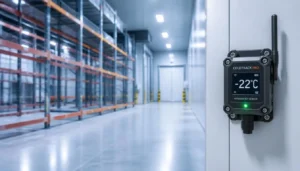
For years, cold chain facility managers relied on clipboard checklists and manual data loggers to track internal warehouse climates. However, relying on personnel to manually read a thermometer every few hours leaves your operations highly vulnerable to unrecorded temperature spikes and human error. In today’s regulatory landscape, manual tracking is no longer sufficient. Implementing a modern system for IoT temperature monitoring has shifted from an optional operational upgrade to a strict regulatory baseline. Transitioning to automated, digital tracking loops is the only reliable way to protect high-value inventory, streamline your record-keeping, and maintain absolute transparency across your supply chain.
The Regulatory Mandate: Why Manual Cold Storage Logs Fail 2026 Audits
The era of using handwritten logbooks to clear warehouse inspections is officially over. Regulatory bodies in India have significantly tightened enforcement protocols, eliminating old loopholes and grace periods. If your facility handles pharmaceuticals, sticking to paper logs will instantly fail a Revised Schedule M compliance audit. Similarly, if you store perishable foods, you are now subject to strict FSSAI digital traceability rules that mandate unalterable, automated historical records.
When an inspector walks into your facility today, they evaluate your documentation using the global ALCOA+ data integrity framework. This benchmark requires all temperature records to be Attributable, Legible, Contemporaneous, Original, and Accurate. Handwritten clipboards fail this test because they leave hours of unmonitored space between physical walks. If an evaporator fan fails twenty minutes after a technician completes their rounds, the temperature could spike for three hours before anyone notices.
An automated digital sensor, by contrast, removes human bias completely. It creates an unalterable, time-stamped record of your internal climate every single minute, providing the precise data proof required to protect your operating licenses during surprise physical audits.
Key Insight: Regulatory compliance is no longer a matter of checking boxes at the end of the day. Modern audits demand continuous, automated proof that your storage environment never deviates from its validated technical boundaries.
Sensor Network Architecture: Deploying Ruggedized Hardware in Sub-Zero Zones
Moving away from paper charts requires setting up a resilient physical network that can withstand harsh operating environments. Designing a system for remote cold room control means deploying sensor nodes built to survive extreme temperatures. Standard electronics fail quickly in industrial freezers due to rapid battery drain at -20°C and moisture ingress during defrost cycles.
A reliable setup uses industrial-grade cold storage wireless data logger nodes equipped with specialized lithium thionyl chloride batteries. These power cells are chemically engineered to maintain stable voltage outputs in freezing temperatures.
Additionally, the placement of the actual sensor probe is critical. If a sensor hangs out in the open, it will register a temporary spike in air temperature every time a forklift driver opens the door, triggering false alarms. To prevent this, engineers use product-simulation probes inserted into thermal mass probes such as glycol bottles or nylon blocks. These blocks mimic the actual internal temperature of your products, ensuring your automated alerts only fire when your stock is genuinely at risk.
Key Insight: Raw air temperature changes too quickly to give you an accurate picture of your stock. Measuring core product temperatures using stabilized thermal mass blocks protects your products and keeps your system free of false alarms.
Overcoming the Faraday Cage Effect: Signal Penetration and Gateway Deployment
Once your sensors are mounted inside the room, the next major challenge is transmitting that data to the outside world. Standard wireless frequencies like 2.4 GHz Wi-Fi struggle in these environments because a cold room is essentially a giant metal box that blocks radio signals.
To break through these metal walls without drilling holes that ruin your vapor seal, engineers avoid Wi-Fi and deploy sub-GHz telemetry networks like LoRaWAN. These lower frequencies feature long wavelengths that easily pass through heavy steel skins and high-density insulation panels.
These signals are collected by heavy-duty industrial edge gateways mounted just outside the cold room. These gateways do more than just pass data along; they act as local processing hubs. If your facility loses its main internet connection, the edge gateway automatically stores and buffers the incoming sensor data on internal storage, preventing data gaps. Once the internet connection is restored, the gateway uploads the buffered data to the cloud, ensuring your digital audit trail remains completely intact. To see how these communication setups integrate with your physical walls and infrastructure, look at our comprehensive Cold Room Components and Hardware Guide.
Key Insight: Standard office Wi-Fi cannot cut through industrial metal-clad panels. Deploying low-frequency wireless nodes paired with smart edge gateways ensures your data keeps flowing to the cloud, even during unexpected internet outages.
The Automated Dashboard: Transforming Live Telemetry Into Preventative Action
The real power of an industrial sensor network comes from the software layer that processes the raw data. Implementing automated temperature surveillance means connecting your physical sensors to a centralized, cloud-based platform that actively monitors your warehouse operations 24/7.
A high-performance real-time telemetry dashboard converts complex data points into clean visual tracking models. Instead of forcing your team to scroll through endless spreadsheets, the software flags anomalies using automated threshold rules.
For instance, you can configure the dashboard to send immediate notifications if a chiller room climbs above 5°C for more than fifteen continuous minutes. This early warning system can also identify hidden mechanical issues. By tracking how long it takes your room to recover after a loading cycle, the software can spot early signs of compressor fatigue or a leaking door gasket long before the equipment completely breaks down.
Key Insight: A modern monitoring platform does more than just record history. It uses continuous data trends to flag early machinery issues, allowing you to schedule maintenance before minor wear turns into an expensive breakdown.
Mitigating Batch Losses: Real-Time Alerts and Emergency Response Workflows
When a major cooling system fails, every minute counts. For high-value commodities like biological pharmaceuticals or export-grade seafood, a single prolonged system failure can lead to devastating product losses ranging from ₹20 Lakhs to over ₹50 Lakhs.
To mitigate these risks, your monitoring system must use multi-channel temperature excursion alerts. When a threshold breach is detected, the cloud platform automatically sends urgent alerts via SMS, phone calls, and mobile app notifications to your on-call engineering team.
To ensure these warnings aren’t missed, the software uses automated escalation workflows. If the primary on-duty technician fails to acknowledge the alert within five minutes, the system automatically escalates the notification to the facility manager. This rapid response loop gives your team the time needed to move inventory or arrange for emergency assistance before your stock sustains permanent damage. If you ever need to address structural leaks or hardware failures caught by these sensors, scheduling professional commercial cold room repair can help secure your facility’s thermal envelope quickly.
Key Insight: Automated alerts are only effective if they lead to immediate action. Setting up a strict, multi-tier escalation workflow ensures that critical system faults are handled promptly, protecting your high-value inventory from catastrophic product losses.
Operational Return on Investment: Energy Optimization and Subsidy Integration
Deploying a sensor network does more than just satisfy government inspectors; it also serves as a powerful tool for lowering your monthly operating costs. Investing in automated infrastructure provides a direct financial return by optimizing your daily power consumption and lowering your total risk profile.
A primary driver of this financial return is active energy tracking. By linking wireless door contact sensors with your climate data, the system monitors exactly how much energy is wasted when loading bay doors are left open too long. Correcting these simple operational habits and balancing your cooling loops based on live data can lower your monthly energy bills by 15% to 30%.
Furthermore, having an automated tracking system is a major advantage when applying for government financial aid. Modern assistance programs prioritize funding for smart, energy-efficient facilities. If you are operating in the local market, maintaining an unalterable digital audit trail that proves your facility meets strict structural modernization benchmarks can streamline your approval process under the NHB subsidy process in Karnataka, helping you recover a significant portion of your capital investment.
Key Insight: Modern monitoring networks pay for themselves. The data gathered to clear your regulatory audits can also be used to eliminate wasted energy and secure valuable government subsidies, boosting your long-term profitability.
FAQs: Managing IoT Networks and Hardware Compliance in Cold Storage
Building or upgrading an industrial cold storage room can leave operators with several immediate, practical questions. Navigating technical sensor specifications requires clear, data-driven answers. Below are responses to the most common engineering inquiries regarding hardware selection and system troubleshooting.
How often do wireless temperature sensors need NIST-traceable calibration?
To comply with global regulatory standards like Revised Schedule M and FSSAI, wireless temperature sensors must undergo formal calibration at least once a year. This process requires a certified technician to verify the sensor’s accuracy against a known reference standard, issuing a traceable certificate that must be logged within your compliance records for future audits.
Can IoT data loggers operate independently of warehouse Wi-Fi networks?
Yes. Industrial-grade IoT data loggers are explicitly designed to bypass unreliable warehouse Wi-Fi networks. They utilize sub-GHz frequencies like LoRaWAN or direct cellular IoT connectivity (such as NB-IoT) to transmit data. This independent network architecture ensures that your climate monitoring loop remains fully functional even if the main facility network crashes.
What backup mechanisms protect data during an extended power outage?
Compliant IoT monitoring systems use a dual-layer backup system. First, individual wireless sensor nodes run on long-life internal batteries that function independently of main building power. Second, the sensor nodes and local edge gateways feature internal storage chips that automatically record and save data locally during an outage, uploading the complete records to the cloud the moment power returns.
Key Insight: Building a secure monitoring network requires planning for system failures. Using sensors with independent power cells, local data backup storage, and sub-GHz wireless paths ensures your facility remains compliant and fully tracked through any operational disruption.
Visit our Google My Business listing to see our recent custom installations! Call Cold Smith Enterprises Today: +91-9632758132